
If you’re trying to get that modern concrete look on your walls, you’ve probably run into two terms that sound interchangeable—but they’re not:
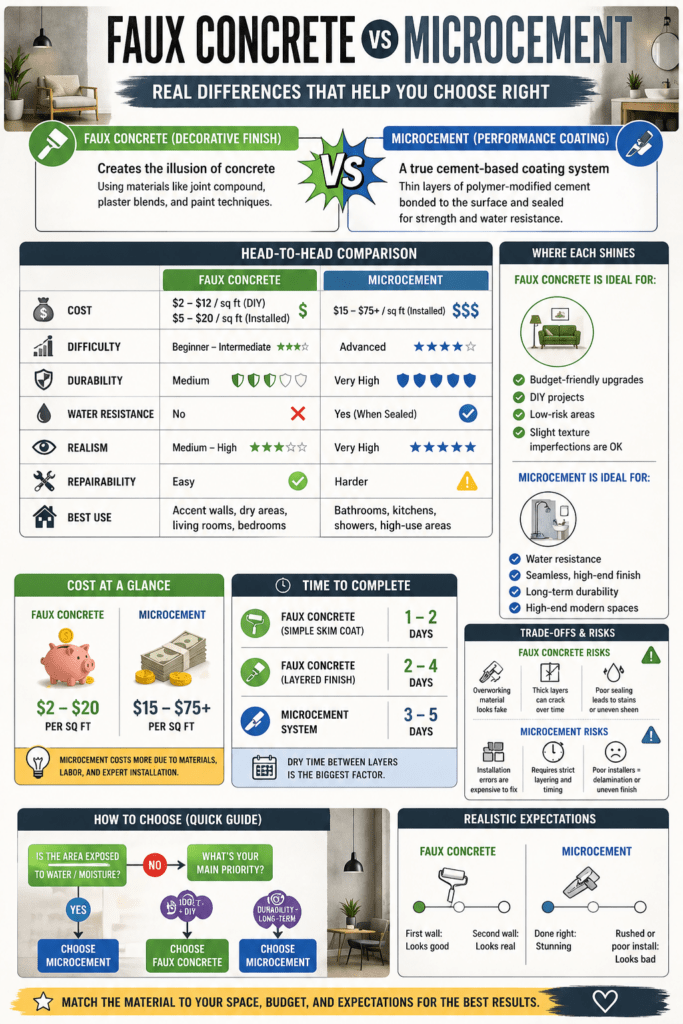
Faux concrete and microcement
I’ve worked with both, and here’s the blunt truth:
👉 They can look similar at first… but they behave very differently over time. If you pick the wrong one for your situation, you’ll either overspend—or end up redoing the wall. Let’s break this down in a way that actually helps you decide.
What’s the Real Difference?
Faux Concrete (Decorative Finish)
This is a cosmetic system—you’re using materials like:
- Joint compound (skim coat)
- Plaster blends
- Paint layering techniques
It creates the illusion of concrete.
👉 Think: drywall finish + artistic technique

Microcement (Performance Coating)
Microcement is a true cement-based coating system:
- Polymer-modified cement
- Applied in multiple thin layers
- Sealed for durability and water resistance
👉 Think: thin concrete surface bonded to your wall
Where Each One Wins (And Loses)
| Category | Faux Concrete | Microcement |
|---|---|---|
| Cost | Low | High |
| Difficulty | Beginner–Intermediate | Advanced |
| Durability | Medium | Very High |
| Waterproof | No | Yes (when sealed) |
| Realism | Medium–High | Very High |
| Repairability | Easy | Harder |
| Best Use | Accent walls | Bathrooms, kitchens, high-use areas |
Cost Comparison (What You Actually Pay)
Faux Concrete
- $2 – $12 per sq ft (DIY materials)
- $5 – $20 per sq ft (installed)
Microcement
- $15 – $75+ per sq ft installed
👉 That’s not a small jump—you’re paying for skill and system durability.
Decision Guidance (Don’t Overthink This)
Here’s how I’d simplify it:
Choose Faux Concrete If:
- You’re doing a living room or bedroom wall
- You want a budget-friendly upgrade
- You’re okay with minor imperfections
👉 This is the best “bang-for-buck” visual upgrade.
Choose Microcement If:
- You need water resistance (bathroom, backsplash)
- You want a seamless, high-end finish
- You don’t want to redo it later
👉 This is a long-term surface, not just a look.
Trade-Offs & Risks Most People Miss
Faux Concrete Risks
- Overworking the material → looks fake
- Thick layers → cracking over time
- Poor sealing → stains or uneven sheen
👉 The biggest issue isn’t the material—it’s technique.

Microcement Risks
- Installation errors are expensive to fix
- Requires strict layering and timing
- Poor installers = delamination or uneven finish
👉 This is not a “learn as you go” system.
Realistic Expectations
This is where I see people get it wrong.
Faux Concrete
- First wall: looks good
- Second wall: looks real
👉 There’s a learning curve, but it’s forgiving.
Microcement
- Looks incredible when done right
- Looks terrible when rushed
👉 There’s no shortcut—precision matters.
Time to Complete
| Method | Time |
|---|---|
| Faux concrete (simple skim coat) | 1–2 days |
| Faux concrete (layered finish) | 2–4 days |
| Microcement system | 3–5 days |
Dry time between layers is the bottleneck for both.
Product & Process Guidance
- Faux concrete prep guide
- Best materials for faux concrete walls
- Common faux concrete mistakes and fixes
Printable Checklist

Faux Concrete vs Microcement Decision Checklist
- ☐ Is the wall exposed to water or moisture?
- ☐ Is this a high-traffic or impact area?
- ☐ What’s your total budget per wall?
- ☐ Do you want DIY or professional install?
- ☐ Are you okay with slight imperfections?
- ☐ Do you need long-term durability (10+ years)?
- ☐ Is this a focal wall or background wall?
👉 If you check “moisture + durability” → microcement
👉 If you check “budget + DIY” → faux concrete
Frequently Asked Questions
Is microcement worth the extra cost?
If you need durability or water resistance—yes. Otherwise, faux concrete often delivers similar visual results for much less.
Can faux concrete look as real as microcement?
It can get close—but microcement has more natural depth and consistency.
Does microcement crack?
Properly installed systems are flexible and resist cracking. Most failures come from poor prep or rushed installs.
Can you apply both over drywall?
Yes. Both systems can be applied over properly prepped drywall or existing surfaces.
Which is better for resale value?
Microcement tends to add more perceived value in kitchens and bathrooms. Faux concrete is more aesthetic than structural.
Resources
- American Concrete Institute – Surface prep and finishing basics
https://www.concrete.org - National Association of Home Builders – Interior wall best practices
https://www.nahb.org - International Code Council – Material and wall safety standards
https://www.iccsafe.org
Final Take (What I’d Do)
If I’m doing:
- Accent wall in a living space → faux concrete
- Bathroom or kitchen → microcement
- Whole room with high-end goal → microcement (pro install)
Don’t overbuild the solution.
A lot of people jump to microcement when a well-done faux finish would’ve given them 90% of the look for 30% of the cost.
Conclusion
Faux concrete and microcement aren’t competitors—they’re tools for different jobs.
One is about visual impact on a budget.
The other is about performance and longevity.
If you match the material to the environment and your expectations, both can look incredible. If you mismatch them—you’ll notice it every day.